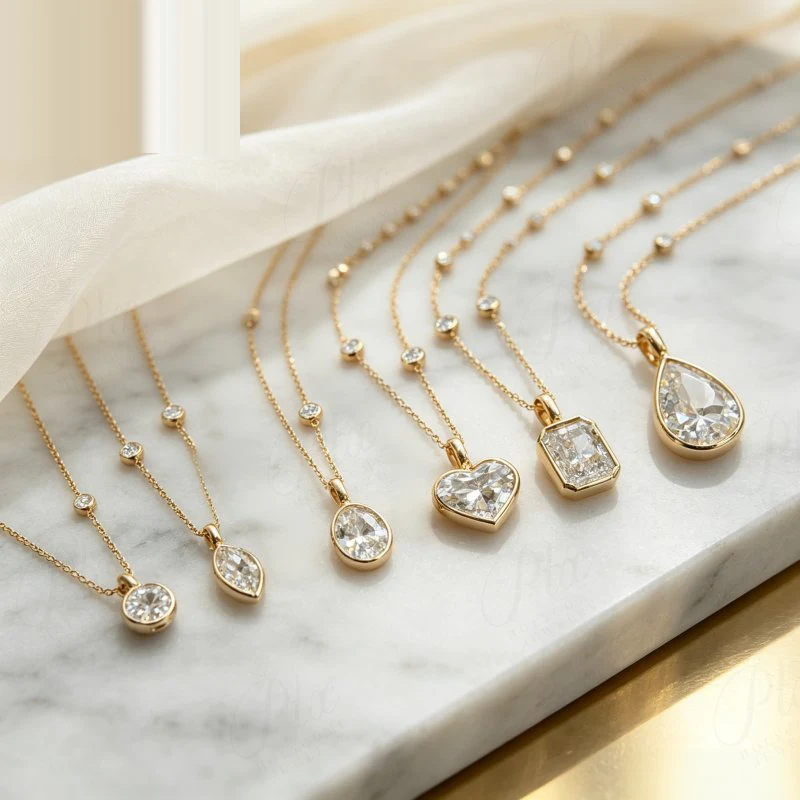
Birthstone Pendant Meanings: What Each Stone Signals to the Wearer

Styling & Trends — the notes below follow the order we actually quote, sample and ship these pieces.
Why meaning sells birthstone jewelry
Customers do not buy a garnet because they need a dark red stone. They buy it because January belongs to someone they love. The meaning attached to each birthstone is what justifies the price and what the sales associate should be able to say in one sentence. This reference keeps that language accurate and avoids mixing modern and traditional lists.
January through June
January - Garnet
Garnet carries the language of protection and safe return, historically worn by travelers. It is a deep, grounded red that photographs well in silver bezels and suits a first-time birthstone buyer because the color is neutral enough for daily wear.
February - Amethyst
Amethyst is tied to calm and clarity, and its violet tone reads as premium against sterling silver. It is the easiest February stone to sell because the color flatters most skin tones and pairs with both casual and formal wardrobes.
March - Aquamarine
Aquamarine carries freshness and water, a pale blue-green that suits spring birthdays. Spec it as light, not dark; an over-dark aquamarine reads as a cheap blue topaz. A 6mm faceted drop in silver keeps the stone airy.
April - Diamond or white topaz
April traditionally points to diamond, and the meaning is endurance and clarity. For price-sensitive gift buyers, a white topaz or cubic zirconia in a silver bezel delivers the same bright white sparkle at a fraction of the cost. State the material plainly on the tag to avoid confusion.
May - Emerald
Emerald speaks of growth and renewal. Real emerald is included and soft, so many silver lines use lab-grown emerald or green glass for consistency. Either way, a prong or bezel that protects the stone's edges matters.
June - Pearl, alexandrite, or moonstone
June is the flex month, with three traditional options. Pearl reads classic and bridal; moonstone reads modern and ethereal; alexandrite is rare and pricey. Most silver lines stock moonstone because it holds its milky sheen and suits everyday pendants.
July through December
July - Ruby
Ruby carries passion and vitality. A lab-created ruby in sterling silver gives the true red without the price jump of a mined stone. It is a strong birthday gift for partners and mothers.
August - Peridot, sardonyx, or spinel
Peridot is the familiar August stone, a lime green tied to warmth. It can look oily under poor lighting, so spec a faceted cut rather than a smooth cabochon to keep it bright.
September - Sapphire
Sapphire signals wisdom and loyalty, and the blue reads as dependable. It is the most giftable of the autumn stones because the color pairs with silver and gold alike. A lab-grown sapphire keeps the saturation even across inventory.
October - Opal or tourmaline
Opal carries color play and softness, but it is fragile - a 5.5 to 6 on the hardness scale. Spec opal only in a closed bezel, never a prong that risks chipping. Tourmaline offers a sturdier alternative in pink or green.
November - Topaz or citrine
Citrine, the warm golden yellow, is the default November stone and carries the mood of gratitude. It is affordable, durable, and stacks well with other autumn tones in a multi-stone family pendant.
December - Turquoise, blue topaz, or tanzanite
Turquoise is the opaque, bohemian December choice; blue topaz is the faceted, bright alternative. Mixing the two across a December line gives customers a casual and a formal option.
Modern versus traditional lists
Several months carry more than one stone because the national jeweler's association updated the list in 1912 and again more recently. June, August, and December are the most affected. When a customer expects a specific stone - say, December blue topaz rather than turquoise - do not force the traditional alternative. Stock both. Label them as the traditional and the modern option so the choice is transparent rather than confusing.
Multi-stone family pendants
The highest-margin birthstone product is not a single stone but a cluster: a bar or oval set with the birthstones of a partner and children, ordered by month. These sell around Mother's Day and push past the single-stone price point easily. Keep the bezel sizes small - 3 to 4mm - so six stones fit on a 30mm bar without crowding. Run the family-bar SKU as made-to-order because the combinations are too many to stock.
Hardness and setting notes
Spec the setting to the stone. Opal and pearl below hardness 6.5 need closed bezels that cover the girdle. Sapphire, ruby, garnet, and aquamarine above 7 take prongs safely. Turquoise is soft and porous; avoid silver dip cleaners on a turquoise pendant, which discolors the stone. A one-line care card with each birthstone pendant prevents most return questions.
Matching meaning to the recipient
A mother's pendant often carries a child's birthstone, so offer multi-stone family bars. A first birthday gift suits a single stone on a fine chain. A milestone anniversary suits the spouse's birthstone set in a slightly larger bezel. Keep the stone size consistent within a collection so customers can build a set year over year. For the full monthly range, see our birthstone pendants.
Authoritative References
For buyers who need to verify the technical and regulatory basis of this guide, the following independent institutions publish authoritative reference data:
- GIA Gem Encyclopedia - independent grading and identification reference for natural and lab-grown gems.
- Wikipedia: Moissanite - peer-reviewed background on moissanite chemistry, optics and history.
Frequently Asked Questions
Which chain lengths should I stock first?
16 to 18 inch covers most necklines and gift purchases. Add 20 inch for layering sets and 24 inch for pendant lines.
Are your chains nickel-free and hypoallergenic?
Yes. Sterling silver is 92.5% silver; stainless lines use 316L. Both are nickel-safe for reactive customers when plated correctly.
Can necklaces be personalized?
Laser engraving on pendants and clasps is available from 50 pieces, with 3–5 day turnaround on the engraving step.
What is the bulk lead time?
15–20 days under 500 pieces; 25–30 days for custom pendants or new molds.
Every figure here is quoted from our own bench in Wuzhou.
Send a spec sheet