Foreign-Script Name Necklaces: Getting Hebrew, Arabic, and Cyrillic Right
Engraving & Personalisation — the notes below follow the order we actually quote, sample and ship these pieces.
A name necklace usually shows up as a first name in a flowing cursive, spelled in the Latin alphabet. But a surprising number of customers want something different: the same name written in Hebrew, Arabic, Cyrillic, Greek, Hangul, katakana, or Devanagari. Often it is the name on a marriage document, a grandparent's given name, a Hebrew name chosen at a baby naming, or an Arabic name a spouse uses at home. The Latin version is convenient. The script version is the one that feels true.
Ordering one is not the same as ordering an English cursive nameplate. The tools, the letterforms, and the failure modes all change. Here is what actually happens on the bench and where orders tend to go sideways.
Why 925 silver is the right canvas for non-Latin letters
Non-Latin scripts are often more complex than Latin. Hebrew letters have small feet and serifs; Arabic joins letters into flowing strokes with diacritic marks above and below; Cyrillic has letters like Ж and Щ that pack multiple strokes into a single character. To hold that detail, the metal needs to be firm enough to cut cleanly but not so hard that the bur skips. 925 sterling silver hits that balance. It is the reason most ateliers that specialize in script nameplates work in sterling rather than plated brass or stainless.
It also polishes well. A high polish on the face makes the engraved or cast letters read clearly, and the metal can be finished matte if the customer wants a quieter, more contemporary look.
The number-one mistake: relying on Google Translate
The most common problem is not the metal. It is the spelling. Customers paste a word from a translation app, and that word may be a transliteration, a modern colloquial form, or a word that means something slightly different from what they intended. A name is a name, but the script has conventions: Hebrew uses final forms for letters that end a word; Arabic requires contextual letter shapes (isolated, initial, medial, final); Cyrillic has phonetic equivalents that are not one-to-one with English. A designer who knows Latin cursive does not necessarily read these scripts.
The fix is simple. Before checkout, ask the workshop to send a vector proof of the exact letters, then have a fluent reader in your family check it. Five minutes on WhatsApp saves a piece you would otherwise quietly stop wearing. Reputable shops do this as a matter of course and will not engrave until the proof is approved in writing.
Casting versus engraving, by script
Nameplates in the Latin alphabet are usually cast: the name is drawn in a chosen font, a mold is made, and the sterling is cast into it. That method also works for Hebrew, Greek, Cyrillic, and Hangul, because the letterforms sit on a baseline and cast cleanly.
Arabic and Devanagari are a different story. Because letters join and change shape depending on their neighbors, the script has to be laid out as a single connected calligraphic stroke, not as separate characters. Casting from a properly drawn Arabic word looks beautiful. Engraving Arabic letter by letter on a flat bar almost always looks wrong, because the joins disappear. If you are ordering an Arabic name pendant, ask whether the shop casts connected calligraphy or engraves isolated characters, and choose the former.
Chain and size considerations
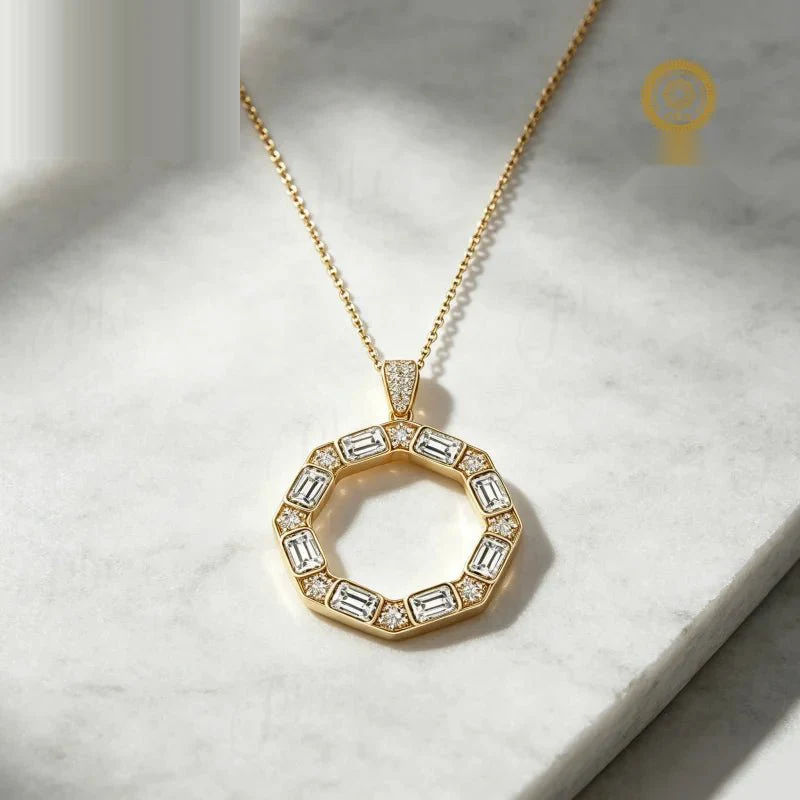
Non-Latin pendants often look best slightly larger than a Latin cursive nameplate, because the letters need room to breathe. A 16- to 18-inch chain sits the pendant at the collarbone, which is where the detail is visible. If you are layering, a longer 20-inch chain places the script below the collarbone where it can peek out above a neckline. Avoid very fine chains under 1 mm with a solid silver nameplate; the weight of the pendant will pull the chain and may stretch it.
Who this gift suits
Foreign-script name pendants are natural for intercultural families, for people reconnecting with heritage, for converts who have taken a Hebrew or Arabic name, and for children of immigrants who want to wear the name their grandparents used. They also make unusually thoughtful personalized gifts for a partner whose name you have only ever seen on an English-language document. A well-made name necklace in the right script is the kind of piece that stays in a jewelry box for decades, because the story behind it does not fade.
If you are unsure which script your family uses, ask the oldest living relative before you order. The proof you get back from the workshop is the easy part. The spelling is the gift.
A note on pricing and lead time
A foreign-script nameplate usually costs a little more than a Latin cursive one, because the layout step is manual. A designer has to type the word into the correct font, check the contextual forms, and often redraw joins that did not survive the font's kerning. Add that up and you are looking at a few extra days in production and a modest upcharge. It is worth it. A mis-rendered script pendant is unwearable in a way a misspelled English nameplate at least admits to. When the quote comes back, do not shop it down to the cheapest shop; shop it to the shop that shows you a proof and waits for your reply.
Authoritative References
For buyers who need to verify the technical and regulatory basis of this guide, the following independent institutions publish authoritative reference data:
- ISO 9001 Quality Management - the international standard for consistent production quality.
- Wikipedia: Jewelry - manufacturing processes, materials and global trade background.
Frequently Asked Questions
Which chain lengths should I stock first?
16 to 18 inch covers most necklines and gift purchases. Add 20 inch for layering sets and 24 inch for pendant lines.
Are your chains nickel-free and hypoallergenic?
Yes. Sterling silver is 92.5% silver; stainless lines use 316L. Both are nickel-safe for reactive customers when plated correctly.
Can necklaces be personalized?
Laser engraving on pendants and clasps is available from 50 pieces, with 3–5 day turnaround on the engraving step.
What is the bulk lead time?
15–20 days under 500 pieces; 25–30 days for custom pendants or new molds.
Every figure here is quoted from our own bench in Wuzhou.
Send a spec sheet