A Silver Pendant for Everyday Wear: Styling and Sourcing Notes
Styling & Trends — the notes below follow the order we actually quote, sample and ship these pieces.
Not every silver pendant earns a place on a customer's neck for twelve hours a day. The everyday pendant is a specific product: small enough not to catch, smooth enough not to scratch, and neutral enough to pair with whatever the customer wears that day. Retailers who build a dedicated everyday wall move pieces that sell through continuously, unlike statement pendants that spike and stall after a single season.
What makes a pendant truly everyday
Start with profile. A pendant that sits flat against the chest and has no raised prongs survives a turtleneck, a seatbelt, and a phone held to the ear. Bezel-set stones and solid geometric shapes dominate this category because they have no exposed edges. Anything with dangling bits, moving parts, or tall prongs belongs on the evening wall, not the daily one. Customers who try to wear a pronged pendant daily report catching it on their hair, their sweater, and their steering wheel, and that friction ends the relationship with the piece.
Weight should feel present but not load-bearing. A pendant near two to three grams on a 1.2 to 1.5mm chain sits naturally without pulling. Heavier pendants drag necklines and feel like a task by lunchtime, which is not what a customer who intends to wear it daily expects. Lighter pendants under a gram can feel flimsy, so the two-to-three-gram range is the sweet spot that balances presence and comfort.
The shapes that repeat
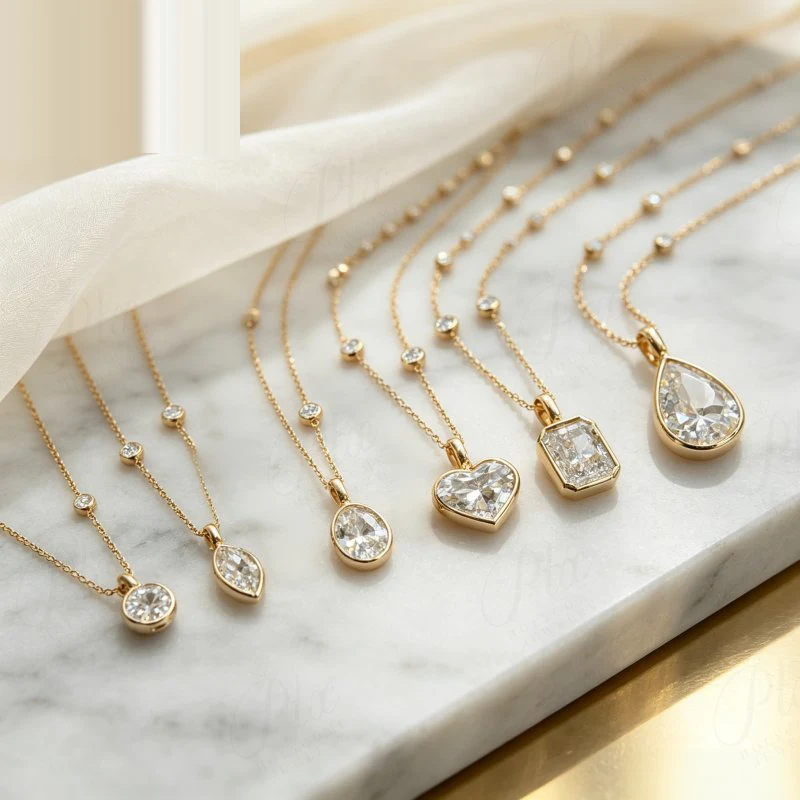
Solid discs, small circles, thin bars, and softened teardrops are the everyday staples. They layer cleanly, they photograph in neutrals, and they carry a tiny initial or stone without becoming fussy. Stars and hearts work in small, flat versions, but large or three-dimensional shapes feel like themed pieces once the trend window passes. Geometric shapes also photograph consistently on model shots, which matters for e-commerce where the customer cannot touch the piece.
Textured finishes matter. A high-polish pendant shows every fingerprint and water spot. Brushed or satin finishes hide daily wear and look intentional rather than neglected. For a daily-wear wall, a brushed finish is the more forgiving default, with polished reserved for the dress tier. Oxidized recesses add dimension but can darken skin at the contact point, so test that on samples before stocking an oxidized design for daily wear.
Chain length and layering logic
The 18-inch chain is the everyday default: it lands at the collarbone and works with crew necks and open collars alike. For customers who want to layer, offer a 16-inch and a 20-inch pairing so two pendants separate rather than stack into a tangle. A two-inch extender on the 18-inch piece handles sweater season without a separate SKU. Lobster clasps at this gauge are small but reliable; avoid spring rings on layered chains because they slip when a second chain brushes against them.
Chain texture should stay quiet. A plain cable chain keeps the focus on the pendant; a heavy rope chain competes with it. For layering, mix fine textures rather than doubling the same chain, which reads as a matched set rather than a curated stack. Keep all the chains on the wall in a similar gauge so a customer can pick two pendants and know the chains will sit together without one overpowering the other.
How to merchandise the everyday wall
Display these on a neck form in real lighting, not under harsh case spotlights, because the customer is buying how it looks over a shirt. Group by metal finish rather than by shape: all polished pieces together, all brushed together, so a customer can build a cohesive stack. Price the everyday tier below the statement tier so it reads as an accessible add-on, and keep a replenishment model rather than a seasonal buy, since these sell steadily all year. Staff should be trained to hand customers a mirror and a second chain so they can see the layered effect; the sale doubles once the customer sees it layered.
Care for a daily pendant is simpler than customers expect. Sterling silver naturally oxidizes where skin and air meet, so a monthly wipe with a polishing cloth keeps the brushed finish even without aggressive buffing. Advise customers to store the pendant in a closed pouch rather than open on a dresser, because exposure to air speeds tarnish. A pendant that stays shiny on the neck stays on the neck, which is the whole point of an everyday piece. Avoid chemical dips, which strip the brushed finish and leave the silver looking patchy.
More on our silver pendant range for building a daily-wear wall.
Sourcing checklist
- Favor flat bezel settings and geometric solids over pronged or dangly shapes.
- Target two to three grams on a 1.2 to 1.5mm chain for daily comfort.
- Choose brushed or satin finishes to hide wear.
- Stock 16, 18, and 20-inch chains so layering works without tangling.
Authoritative References
For buyers who need to verify the technical and regulatory basis of this guide, the following independent institutions publish authoritative reference data:
- Wikipedia: Sterling Silver - the 92.5% silver alloy standard and hallmarking conventions.
- ISO 9001 Quality Management - the international standard for consistent production quality.
Frequently Asked Questions
Which chain lengths should I stock first?
16 to 18 inch covers most necklines and gift purchases. Add 20 inch for layering sets and 24 inch for pendant lines.
Are your chains nickel-free and hypoallergenic?
Yes. Sterling silver is 92.5% silver; stainless lines use 316L. Both are nickel-safe for reactive customers when plated correctly.
Can necklaces be personalized?
Laser engraving on pendants and clasps is available from 50 pieces, with 3–5 day turnaround on the engraving step.
What is the bulk lead time?
15–20 days under 500 pieces; 25–30 days for custom pendants or new molds.
Every figure here is quoted from our own bench in Wuzhou.
Send a spec sheet