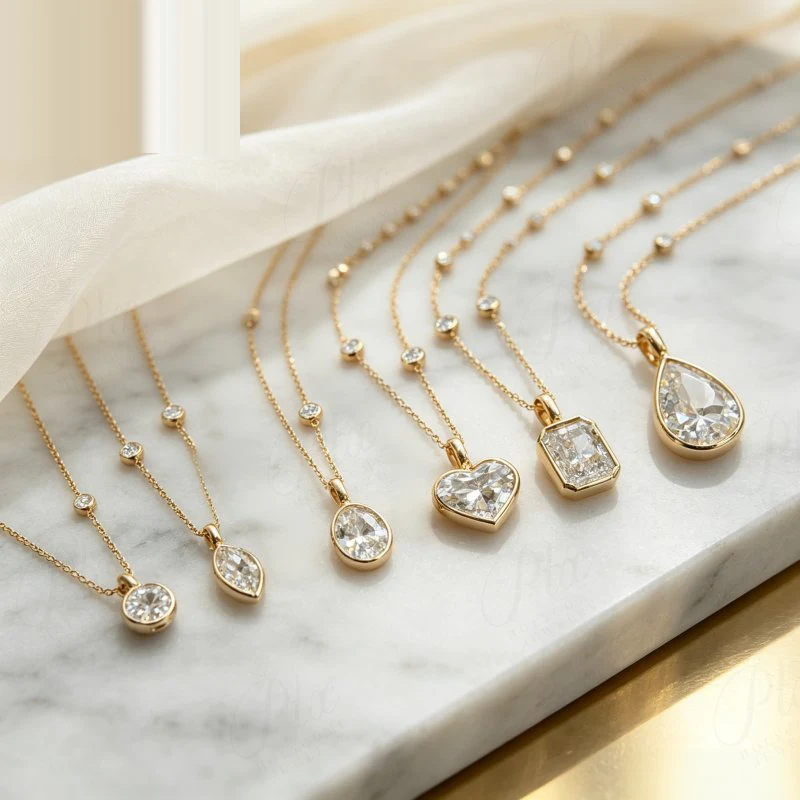
Layering Initial Pendants Without the Tangling
Styling & Trends — the notes below follow the order we actually quote, sample and ship these pieces.
Two initial pendants on one chest should look deliberate. When it goes wrong, it looks like a tangled pile of metal around the collarbone. The difference is not the customer's styling skill. It is the chain spec. Buyers who sell initial pendants as a layering category need to hand the customer the rules at the moment of purchase, or she will come back with a knotted chain and a complaint.
The length math
The first pendant sits at 16 inches, high on the collarbone. The second pendant sits at 18 inches, two inches lower. The third sits at 20 inches. That two-inch gap is the minimum. At less than two inches, the pendants touch and twist together. At more than three inches, the lower pendant starts to look like a separate necklace rather than part of a set. A customer who wants three initials needs chains at 16, 18, and 20 inches. Selling her two pendants on the same 18-inch chain is the single most common layering mistake in the category.
Where the initial lands
A 16-inch chain puts the pendant just below the hollow of the throat. That is the right spot for the smallest initial, usually an 8mm disc. The 18-inch chain puts a 12 to 14mm pendant at the collarbone. The 20-inch chain puts a 14 to 16mm pendant mid-chest. The pendants should step down in size as the chains get longer, not up. A small pendant on a long chain floats and disappears; a large pendant on a short chain crowds the throat.
The weight rule
The pendants on the shorter chains should be the lighter ones. If a 3-gram pendant sits on a 16-inch chain and a 1-gram pendant sits on an 18-inch chain, the heavier one drags the lighter one up over the course of a day. The lower chain should carry the weight. That keeps the stack stable. Spec pendants that step up in gram weight as they step down in chain length. A customer buying two pendants should be told this explicitly, because it feels counterintuitive.
The clasp and extender setup
Each chain should ship with a two-inch extender. The customer then adjusts the lengths in real time to her own neck and to the neckline of the top she is wearing. A turtleneck changes the effective length of every chain by an inch. Without extenders, the layering only works on one outfit. The extenders cost cents and remove a large share of the styling complaints.
What not to layer
- Three pendants on chains within one inch of each other. They will knot by lunchtime.
- Two script initials on adjacent chains. The swashes catch and twist. Pair a script initial with a block initial, or with a plain disc.
- A box chain with a rope chain in the same stack. They flex differently and tie themselves into knots.
- Pendants of the same size on the same chest. They compete and look like a mistake.
- Chains thinner than 1mm in a layered stack. They tangle and break.
The one-pendant fallback
Not every customer wants three chains. A single initial pendant at 18 inches on a 1.2mm chain is the cleanest look in the category. It pairs with a watch, a small earring, and nothing else. Buyers should stock this as the default SKU and treat the layered stack as an upsell rather than the baseline. The customer who comes in asking for one pendant should not be pressured into three. The customer who comes in already layering should be handed the length math before she leaves.
How to display it
A bust on the sales floor wearing three layered initial pendants, at the correct lengths, sells the category better than any signage. Customers look at the bust, look at each other, and ask whether they can buy the stack. That is the moment to explain the length rule and the weight rule. A customer who understands the spec will come back for the second and third pendants over the following months. A customer who does not understand the spec will buy two on the same chain, return one, and not come back.
Pairing initials with what she already owns
A layered stack reads best when it joins an existing necklace rather than replacing one. Ask the customer what she wears every day. If she already has a thin gold chain, the silver initials should step in at different lengths and not compete for the same spot. If she wears nothing, start her at 18 inches with one initial and add the second chain in a month rather than forcing the full stack on day one. Customers who are sold three chains at once often return two of them; customers who are sold one and come back for the second keep both.
For the initial discs and chain lengths that layer cleanly
Look at our initial pendant line and order the 16, 18, and 20 inch chains together.
Authoritative References
For buyers who need to verify the technical and regulatory basis of this guide, the following independent institutions publish authoritative reference data:
- ISO 9001 Quality Management - the international standard for consistent production quality.
- Wikipedia: Jewelry - manufacturing processes, materials and global trade background.
Frequently Asked Questions
What ring sizes can you supply in bulk?
US sizes 5–12 including half sizes. Send a size breakdown with your order and we cast to that curve; comfort-fit inner bands reduce resize requests.
Can I order a mixed size run instead of one size?
Yes. Mixed runs are standard for wholesale: specify quantity per size and we pack and label by size at no extra labor cost.
What is the MOQ for custom ring designs?
50 pieces per design for existing molds; 100–300 pieces when a new mold or CAD model is required.
How should I price rings for retail margin?
Most partners use a 3–4x markup on FOB cost for sterling and 2.5–3x for moissanite solos, which keeps landed cost under 30% of retail.
Every figure here is quoted from our own bench in Wuzhou.
Send a spec sheet